|
|
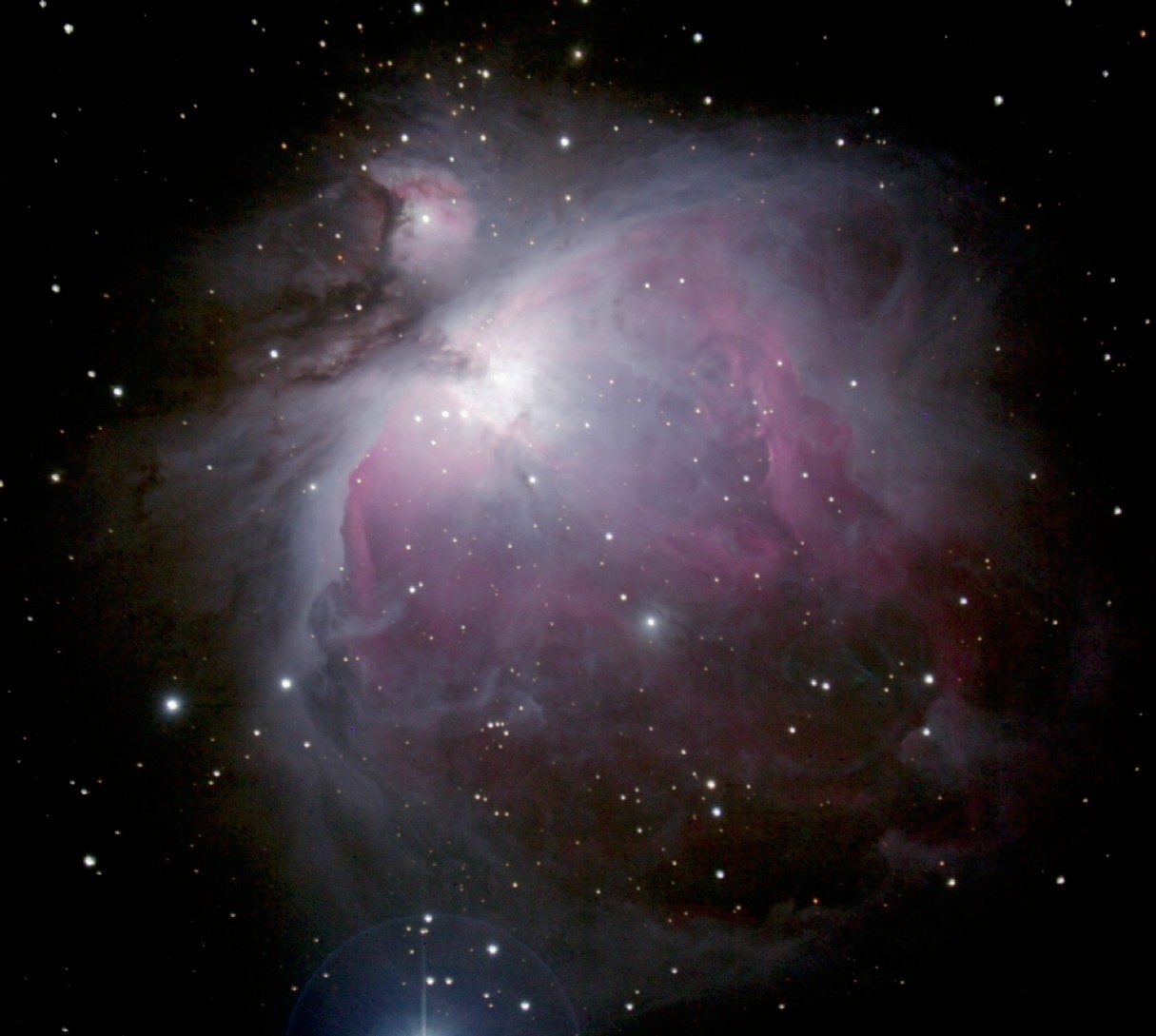
| M42 (& M43) The Great Orion Nebula |
|
The Great Orion Nebulae. The biggest, brightest, most spectacular Deep Space Object (DSO) out there. And it is a "Wow". It is one of those things that comes out of the camera WAY better than your eye can see. Visually it is a rather blah hazy fairly bright piece of nebulosity. But the colors that appear in a photograph are a Wow! M42 is the main bright core and surrounding illuminated gas. M43, the coma shaped star and gas just to the upper left of the main M42, is considered a separate region of this whole area. M42 & 43 can be found in the middle of the sword hanging from the three bright belt stars of Orion. They can easily be seen with just binoculars. The Orion Nebula, at 1500 light years distance, is the closest star birthing area to us. As such it has been and continues to be a much observed and studied area. It was one of the first things the Hubble space telescope turned to when it started operations. Just recently the HST completed a wide field study of this region, going into unprecedented depth and detail throughout a wide range of wavelengths. Already we've learned that over 3000 stars, half of which were discovered in this latest survey, were formed fairly quickly together just a little over 1 million years ago. That is barely a few minutes ago if expressed in human lifetime to cosmic lifetime terms. Areas like this are of interest because we still don't understand nearly as well as we'd like the conditions that surround the star birth and in turn planet formation of places like our earth and sun. Areas like this, and others that are both younger and older are help us slowly put together a better understanding of where we come from and where it's all going. |
|
10"
F6.3 Schmidt Cassegrain telescope, Canon 300D at prime focus |